Why Most WhatsApp Chatbots Are Broken, And What ZEPIC Does Differently
Divya Murugesan
Head of Product Marketing
February 26, 2026
How ZEPIC’s WhatsApp Chatbot is turning customer conversations into real-time business actions
You've probably interacted with a WhatsApp chatbot that felt like a dead end. You tap a button, get a canned reply, tap another button, and eventually hit a wall that says "our team will get back to you."
That's not a chatbot. That's a very expensive FAQ page.
The problem isn't WhatsApp itself. It's how most businesses have been building on it. They've been building bots that reply, when what they actually need are bots that act.
ZEPIC is built on a different premise: every message a customer sends is an intent, and every intent should trigger a real outcome.
The Gap Between "Chat" and "Action"
Think about what happens after a typical chatbot interaction. A customer types "I need to change my delivery address." The bot confirms it received the message. And then... someone on your operations team has to log into Shopify, find the order, update the address manually, and hope it happens before dispatch.
That gap between the conversation and the action is where orders get lost, leads go cold, and customers churn.
ZEPIC closes that gap entirely. When a customer sends "Change my address," the order updates in Shopify automatically. When they say "I'm interested," a deal moves forward in the CRM. When they type "Talk to support," a ticket is created and routed, automatically.
The conversation is the workflow.
What makes ZEPIC different?
No More Spider-Web Flows
Anyone who has tried to build a chatbot flow knows the pain of what often gets called the "decision tree nightmare." You start with a simple journey: greet the customer, ask what they need, route accordingly. Two weeks later, you're staring at a 40-branch diagram that breaks every time you change one condition.
ZEPIC scraps that model. Flows in ZEPIC unfold step by step based on real responses, not pre-mapped decision trees. And crucially, ZEPIC understands natural language, so if a customer doesn't tap a quick reply button and just types what they mean, the AI detects the intent and keeps the flow moving correctly.
This is a meaningful shift. Most chatbot platforms are keyword-dependent: they work only when customers respond exactly as expected. Real customers don't do that. ZEPIC accounts for the messiness of actual human conversation.
What "No-Code" Actually Means Here
There's a lot of noise around "no-code" tools that still somehow require a developer to get anything meaningful done. ZEPIC's builder is genuinely built for non-technical teams. You can design a flow, connect it to your CRM or Shopify store, set up webhook triggers, and go live in a single session.
No developer tickets. No deployment queues. No waiting.
This matters especially for teams that need to move fast: launching a campaign, responding to a product update, or handling a surge in customer queries. When the marketing or customer success team can own the chatbot without engineering dependencies, iteration speed changes dramatically.
Beyond WhatsApp: Multi-Channel, Multi-System
A common misconception is that a WhatsApp chatbot only lives on WhatsApp. ZEPIC connects channels. A flow can start on WhatsApp and branch into email or Instagram based on customer behavior. It also connects systems: Shopify, HubSpot, Zendesk, and any tool that supports webhooks.
This makes ZEPIC less of a chatbot tool and more of an automation layer sitting on top of your existing tech stack. The customer sees a conversation. Behind the scenes, your systems are being updated in real time.
Sending Messages Without Template Approvals
One practical limitation of WhatsApp Business is the template approval process — any proactive message to a customer technically needs pre-approval from Meta. ZEPIC works around this within the rules: inside an active 24-hour conversation window, you can send free-flowing, contextual, dynamic responses with CTAs and buttons without waiting on approvals. This lets your bot respond in ways that feel human and in-the-moment, not templated and robotic.
Real Use Cases Worth Knowing
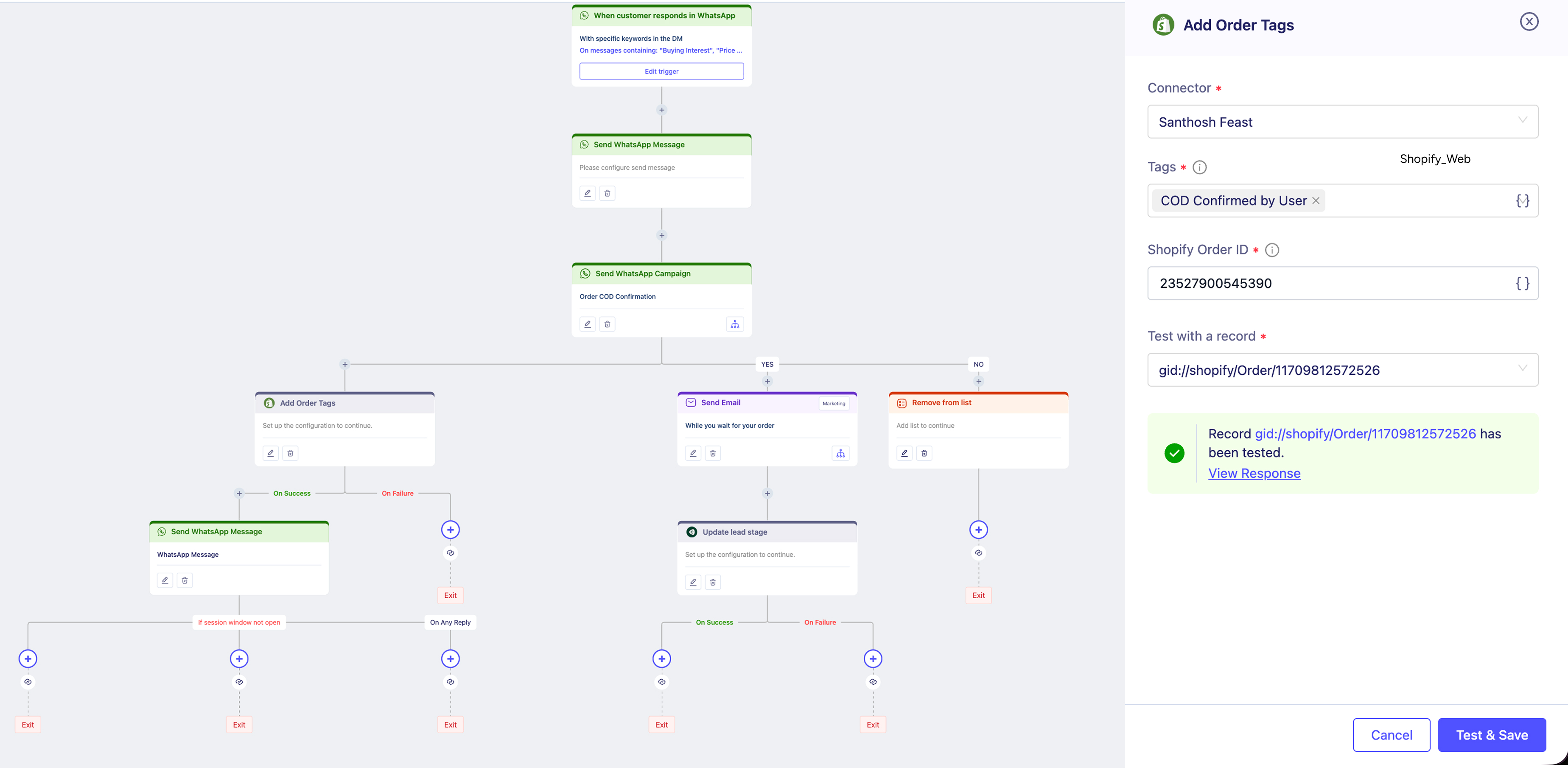
eCommerce—COD Confirmation: Unverified cash-on-delivery orders are a major source of returns. ZEPIC lets customers confirm their order and verify their address in a single WhatsApp thread. Wrong address? They update it on the spot. Your system reflects it instantly.
Real Estate—Lead Capture: Broadcast replies come in fast and go cold just as fast. ZEPIC captures interest, qualifies the lead with a few quick questions, and pushes a fully tagged record into the CRM—before anyone has to pick up the phone.
Travel & Hospitality—Loyalty Redemption: Loyalty programs bleed members when redemption feels like effort. ZEPIC lets travelers check and redeem points directly on WhatsApp. One tap updates the loyalty platform and fires a confirmation — no portals, no friction.
The Bottom Line
WhatsApp has over two billion users. It's already where your customers are. The question is whether your business is using it to simply reply to them or to actually serve them in real time.
ZEPIC's answer is clear: conversations should be commands. Every message a customer sends carries information and intent. Capturing that, acting on it instantly, and connecting it to the systems your business runs on. That's what turns a chatbot from a nice-to-have into a genuine growth lever.
If you're building on WhatsApp and still managing post-chat actions manually, it's worth asking how much that gap is costing you.
Interested in seeing ZEPIC's WhatsApp chatbot in action? Book a demo and see how conversations can become your control room.
Desperate times call for desperate Google/Chat GPT searches, right? "Best Shopify apps for sales." "How to increase online sales fast." "AI tools for ecommerce growth."
Been there. Done that. Installed way too many apps. But here's what nobody tells you while you're doom-scrolling through Shopify app reviews at 2 AM—that magical online sales-boosting app you're searching for? It doesn't exist. Because if it did, Jeff Bezos would've bought (or built!) it yesterday, and we (fellow eCommerce store owners) would all be retired in Bali by now. Growing a Shopify store and increasing online sales isn’t easy—we get it. While everyone’s out chasing the next “revolutionary” tool/trend (looking at you, DeepSeek), the real revenue drivers are probably hiding in plain sight—right there inside your customer data. After working with Shopify stores like yours (shoutout to Cybele, who recovered almost 25% of their abandoned carts with WhatsApp automation), we’ve cracked the code on what actually moves the needle. Ready to stop app-hopping and start actually growing your sales by using what you already have? Here are four fixes that will get you there!
The Painful Truth: You're probably losing about 70% of your potential sales to cart abandonment. That's not just a statistic—it's real money walking out of your digital door. And looking for yet another Shopify app for abandoned cart recovery isn't going to fix it if you're not getting the fundamentals right.
The Quick Fix: Everyone knows you need multi-channel recovery that hits the sweet spot between "Hey, did you forget something?" and "PLEASE COME BACK!" But here's the reality—most recovery apps are a one-trick pony. They either do email OR WhatsApp, not both. And don't even get us started on personalizing offers based on cart value—that usually means toggling between three different dashboards while praying your apps talk to each other.
Enter ZEPIC: This is where we come in. With ZEPIC's automated Flows, you can: Launch WhatsApp recovery messages (with 95% open rates!) Set up perfectly timed email sequences (or vice versa) Create personalized recovery offers not just on cart value but based on your customer’s behavior/preferences Track and optimize everything from one dashboard
Fix #2: Reactivate past customers today
The Painful Truth: You're probably losing about 70% of your potential sales to cart abandonment. That's not just a statistic—it's real money walking out of your digital door. And looking for yet another Shopify app for abandoned cart recovery isn't going to fix it if you're not getting the fundamentals right.
The Quick Fix: Everyone knows you need multi-channel recovery that hits the sweet spot between "Hey, did you forget something?" and "PLEASE COME BACK!" But here's the reality—most recovery apps are a one-trick pony. They either do email OR WhatsApp, not both. And don't even get us started on personalizing offers based on cart value—that usually means toggling between three different dashboards while praying your apps talk to each other.
Enter ZEPIC: This is where we come in. With ZEPIC's automated Flows, you can: Launch WhatsApp recovery messages (with 95% open rates!) Set up perfectly timed email sequences (or vice versa) Create personalized recovery offers not just on cart value but based on your customer’s behavior/preferences Track and optimize everything from one dashboard
Offering light at the end of the tunnel is Google’s Privacy Sandbox which seeks to ‘create a thriving web ecosystem that is respectful of users and private by default’. Like the name suggests, your Chrome browser will take the role of a ‘privacy sandbox’ that holds all your data (visits, interests, actions etc) disclosing these to other websites and platforms only with your explicit permission. If not yet, we recommend testing your websites, audience relevance and advertising attribution with Chrome’s trial of the Privacy Sandbox.
Top 3 impacts of the third-party cookie phase-out
Who’s impacted
How
What next
Digital advertising and acquisition teams
Lack of cookie data results in drastic fall in website traffic and conversion rate
Review all cookie-based audience acquisition. Sign up for Chrome’s trial of the Privacy Sandbox
Digital Customer Experience
Customers are not served relevant, personalised experiences: on the web, over social channels and communication media
Multiply efforts to collect first-party customer data. Implement a Customer Data Platform
Security, Privacy and Compliance teams
Increased scrutiny from regulators and questions from customers about data storage and usage
Review current cookie and communication consent management, ensure to align with latest privacy regulations


%201.png)


.jpg)