How to Turn Transactional Messages Into Sales Opportunities
Anandhi Moorthy
Senior Content Marketer
November 25, 2025
TLDR
Transactional messages (order confirmations, shipping updates, delivery notifications) get 60%+ open rates, far higher than promotional emails.
These high-intent touchpoints are underused because they’re often hardcoded in Shopify or fulfillment systems, leaving marketers unable to edit or optimize them.
Unified customer engagement platforms now let marketers customize transactional and marketing flows in the same journey builder, without developer dependency.
Three high-impact touchpoints to optimize:
Order confirmation: reassure, then offer subtle cross-sells and referral nudges.
Shipping confirmation: provide tracking, plus product tips and anticipation-building content.
Post-delivery: request feedback/reviews and trigger next-purchase nudges.
Optimization requires the right infrastructure, native e-commerce integrations, real-time shipping/delivery data, dynamic content blocks, and journey logic for branching paths.
Many e-commerce brands would kill for a 60–70% open rate on any email. What they don’t realize is that they already send emails that get exactly that.
Transactional messages like order confirmations and critical account updates are the most opened ones in the entire customer lifecycle.
Research shows transactional emails average around a 60% open rate, compared to just 20% for promotional campaigns.
So why are brands pouring creative energy into emails nobody opens, while the most-read messages say nothing but “Thanks for your order”?
Every eCommerce brand knows transactional messages are prime real estate. The problem is that most “optimize your transactional emails” advice ignores the real issue:
These messages are hardcoded.
They live inside Shopify, WooCommerce, or custom backend systems. Marketing teams can’t touch them without developer involvement or sprint cycles.
Unified customer engagement platforms are changing this by bringing transactional and marketing messaging into the same journey builder. This gives marketers control over order confirmations, shipping updates, and post-delivery touchpoints without submitting Jira tickets.
In this guide, you’ll learn:
Why transactional messages are your most underutilized revenue channel
A three-touchpoint framework to unlock sales without being salesy
What to add (and what not to add) to each message
How to actually implement this without getting stuck behind dev teams
Why Transactional Messages Are Untapped (And Why It's Not Your Fault)
Transactional messages consistently outperform promotional ones by a wide margin. Customers might ignore a flash sale or a marketing blast, but they never ignore:
Order confirmations
Shipping updates
Delivery notifications
Account alerts
These messages routinely hit 60%+ open rates, while promotional messages often hover around 15–25%.
What’s the reason behind this gap?
It all boils down to the customer mindset. Since they initiated the transaction, they are eagerly waiting to hear about their order status. These transactional messages bring them the information they are interested in.
So it’s only logical that brands leverage this opportunity to cross-sell or upsell. What’s stopping them from doing that?
The reality on the implementation side is less rosy: Shopify and other e-commerce platforms ship a set of default notifications that are functional but often rigid. Shipping confirmations are often fired directly from fulfillment systems, completely bypassing the marketing stack. And many ESPs treat transactional messaging as a separate product with standalone templates, sender profiles, and compliance rules.
This fragmentation makes it nearly impossible for lifecycle teams to experiment with content, personalization, or sequencing.
The outcome is predictable: transactional messages sit outside the marketing workflow, making iteration slow or non-existent even when everyone agrees they’re prime real estate
But there’s good news. Modern unified customer engagement platforms pull transactional and marketing messages into the same canvas, with native e-commerce integrations that ingest order, shipping, and delivery events in real time.
No-code builders now let marketers:
Drag-and-drop content blocks into order confirmations
Embed personalized product recommendations
Add tips, referral nudges, or dynamic sections
Coordinate email and WhatsApp messaging from a single journey
Test variations without hardcoding or developer dependencies
Once this foundation is in place, every transactional touchpoint evolves from a static receipt into a powerful lever for cross-sell, education, retention, and feedback.
Touchpoint 1—Order Confirmation: Reassure, Then Recommend
The primary job of an order confirmation is to reassure customers that their purchase went through, outline what they bought, and set clear expectations about shipping and support, which directly reduces “where is my order” anxiety and support tickets.
This foundation is non-negotiable in any effective order confirmation messaging strategy and is what makes order confirmations the most trusted touchpoint in transactional marketing.
But once reassurance is delivered, this becomes one of the most powerful, low-friction opportunities in the entire post-purchase messaging sequence. The customer is in a positive mindset because they just completed a purchase, they’re excited, and they’re paying attention. This makes the order confirmation an ideal place to offer gentle value-adds that naturally enhance the experience.
What to Do in an Order Confirmation Message:
Add a subtle, highly relevant cross-sell: “Customers who bought [X] also loved [Y]” works well when limited to one or two complementary products. It drives incremental revenue without feeling pushy.
Include a light referral nudge: A simple line like “Share [Brand] with a friend and get $20 off your next order” reinforces loyalty and encourages early advocacy.
Set clear expectations for what comes next: Outline when shipping updates will begin, estimated delivery timelines, where they can track the order, and how to reach support. This transparency helps reduce WISMO messages and improves the overall experience.
Add a short founder note or brand story snippet: A concise 50–80 word message adds personality and warmth to a typically functional email—something most eCommerce transactional messages overlook.
Implementation Reality Check
This is often where brands get stuck with customizing Shopify order confirmation emails:
Shopify: These notifications live in Liquid templates. Editing them requires developer time or a third-party app. Learning how to customize transactional emails in Shopify becomes a mini-project in itself.
Traditional ESPs: Transactional and promotional emails live in separate modules with limited control, classic transactional vs. marketing platform challenges.
In unified customer engagement platforms (like ZEPIC): Marketers can build the entire order confirmation flow inside a single journey builder, add dynamic product recommendation blocks, and coordinate both email and WhatsApp messages—without touching code.
A unified customer engagement platform removes the technical bottleneck and gives lifecycle teams full ownership.
Best Practices for a High-Performing Order Confirmation
Lead with reassurance: Order details must come first; never bury them under other information.
Keep cross-selling relevant and restrained: Avoid clutter and avoid hard-selling.
Use a single secondary CTA: Beyond “View Order,” pick just one more action.
Use channel strengths:
WhatsApp for instant confirmation
Email for detailed breakdown and recommendations
Expected Outcomes
A well-optimized order confirmation reliably drives:
Higher AOV through contextual cross-sells
More referral program sign-ups
Fewer support queries and “Where's my order?” questions
Smoother progression through the post-purchase sequence
Touchpoint 2—Shipping Confirmation: Build Anticipation, Add Value
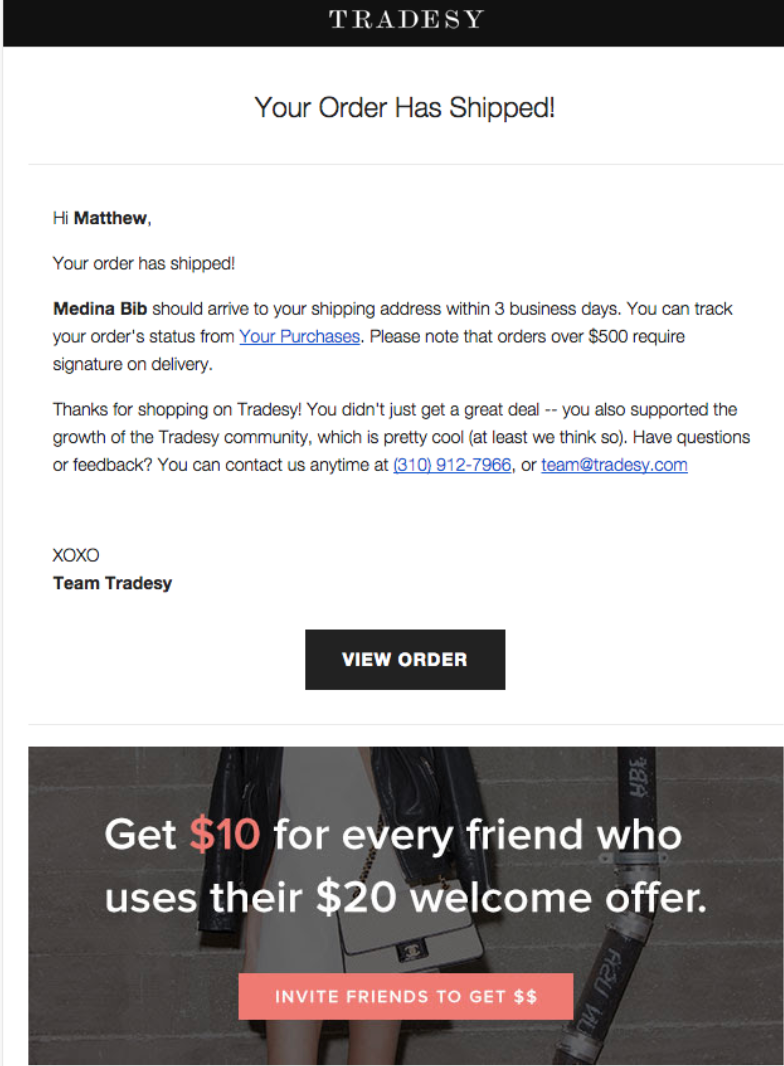
Shipping confirmations exist to answer one question above all others: “Where is my order?” and good implementations put the tracking link and estimated delivery date front and center.
This transparency matters because more than 9 in 10 customers actively track their orders after purchase. A proactive notification about status changes can result in higher satisfaction and loyalty
Once tracking is handled, shipping notifications give you a chance to build anticipation and increase product success by delivering usage tips, styling ideas, or setup guidance tailored to what the customer bought.
For example, a skincare brand might use this email or WhatsApp message to share a simple “first week routine,” while a fashion brand could show three styling suggestions for the purchased item, and a tech brand might link to a quick start video—each of which turns passive waiting time into pre-engagement with the product.
What to Do in a Shipping Confirmation Message
Share short, relevant product tips: “While you wait—here’s how to get the best results from [Product].” This improves product readiness and reduces potential confusion later.
Add usage ideas or first-week guidance: “3 ways to style your new [Product]” or “Your first week with [Product].” These suggestions boost product satisfaction and help customers envision using it.
Invite customers to your community: “Join our Facebook group/WhatsApp community for tips and exclusives.” This strengthens loyalty and brings customers into your brand ecosystem before the product even arrives.
Build anticipation with arrival cues:“Your [Product] arrives on [Day]—here’s what to expect.” This creates excitement and proactively reduces delivery anxiety.
Implementation Reality Check
Shipping confirmations are deceptively complex, and many brands struggle to optimize them because:
Fulfillment systems trigger shipping emails: Platforms like Shiprocket, Delhivery, and Nimbus often send these notifications directly, outside the ESP.
Adding product tips requires custom integration unless you have a platform that listens to shipping webhook events.
WhatsApp shipping updates require BSP integration, and not all platforms support native real-time updates.
Best Practices for High-Performing Shipping Confirmations
Tracking link is non-negotiable—make it prominent
Keep add-on content short and skimmable and link to detailed guides, blogs, or videos.
Match content to product category. For example, skincare → routine guidance, Apparel → styling ideas, and Electronics → setup steps
Use WhatsApp for real-time tracking nudges and email for richer storytelling.
Expected Outcomes
Optimizing this touchpoint leads to:
Reduced Where is My Order(WISMO) queries and support load
Higher product satisfaction even before delivery
Increased engagement with educational and community content
Stronger momentum into the next stage of your post-purchase sequence
Touchpoint 3 – Post-delivery: collect feedback, spark the next purchase
Post-delivery messaging is where the loop closes. Once the product is in the customer’s hands, emotions are at their peak—they’re excited, forming opinions, and fully engaged with your brand. Post-delivery campaigns confirm that the order has arrived, check on satisfaction, and open the door either to recovery or to the next purchase.
Numerous CX studies highlight that customers are more likely to stick with brands that address problems quickly and offer helpful post-purchase support. A study by Forrester shows that customers are 2.4 times more likely to stick with a brand when their problems are solved quickly.
This makes post-delivery campaigns an important touchpoint for long-term revenue.
What to Do in a Post-Delivery Campaign
Send a quick feedback or NPS request:“How was your experience? Quick 30-second survey.” Short surveys get higher completion rates and give you actionable, real-time insight.
Ask for a review at the right moment: “Loving your [Product]? Leave a review and help others discover it.” This captures sentiment when the experience is fresh—a proven best practice for post-purchase review request timing.
Introduce a contextual next-purchase nudge: “Ready for your next favorite? Here’s what pairs perfectly with [Product].” This encourages repeat purchase in a way that feels like helpful personalization, not a hard sell.
Implementation reality check:
Route low scores to instant issue resolution: If a customer gives a low NPS score, automatically open a support ticket or send a personalized apology.
Delivery confirmation relies on carrier systems successfully syncing delivery status back to your e-commerce or customer engagement platform.
Many brands lack reliable "delivered" triggers, often estimating delivery times based on the shipping date, which can cause mistimed follow-ups.
Accurate delivery status requires robust integration with carriers or fulfillment systems to provide real-time updates.
Post-delivery NPS or feedback surveys need journey logic to branch based on customer sentiment—differentiating between promoters who receive referral/review asks and detractors who trigger service outreach.
Address validation and order accuracy upstream also influence the reliability of delivery confirmations and customer satisfaction downstream.
Without reliable delivery data and personalized journey logic, post-delivery messaging risks being poorly timed, irrelevant, or operationally heavy to maintain.
Best Practices for High-Performing Post-Delivery Messages
Wait 48–72 hours after delivery before sending—give customers time to try the product.
Keep surveys short and simple. 1–3 questions yield the best response rates.
Segment follow-ups:
Promoters → referrals or review requests Detractors → recovery and support
Avoid stacking too many requests: Pick one primary CTA per message.
Personalize recommendations based on products purchased and customer history to increase conversion.
Expected Outcomes
Higher review volume and social proof
Actionable NPS data for CX and product teams
Early detection of issues before they escalate
Increased repeat purchases from happy customers
Greater referral program participation
The Infrastructure Question—How to Actually Do This
By now, it’s clear that optimizing your eCommerce transactional messages can dramatically improve retention, satisfaction, and revenue. But knowing what to do is only half the battle. The real challenge for most brands is figuring out how to implement these strategies without drowning in technical debt or developer dependence.
Why Most Brands Struggle
Most teams don’t lack ideas; they lack the infrastructure to execute. The obstacles are structural:
Transactional and marketing messages live in separate systems: This is the core flaw of the traditional transactional vs. marketing platform model. Marketers can’t control transactional flows because they run through backend systems, not the ESP.
Shopify’s default notifications are rigid and developer-dependent: Attempting to customize Shopify order confirmation emails means touching Liquid templates, opening tickets, or installing multiple third-party apps. It’s not marketer-friendly.
Traditional ESPs charge extra or limit customization for transactional messages: Some lock templates behind separate subdomains or require custom APIs for even simple edits.
No unified customer view means no personalization: If order data is in Shopify, shipping data is in ShipBob, and messaging lives in another platform, you have no central source of truth. Personalizing a post-purchase email sequence becomes nearly impossible.
What to Look For in a Platform
To truly unlock the potential of transactional email marketing, you need a platform built for modern D2C retention. Look for:
Unified transactional and marketing messaging: One journey builder for confirmations, campaigns, flows, and post-purchase emails.
Native eCommerce integrations that pull order, shipping, and delivery data into the same system in real time.
Email and WhatsApp in one place: Not separate tools, tabs, or systems—one workflow.
Dynamic content blocks that enable product recommendations and contextual add-ons without hardcoding APIs.
Behavior-based journey logic that can branch on triggers like NPS score, Order value, Product category, Delivery status, and Repeat purchase history
This is what a true unified customer engagement platform looks like.
The Build-vs-Buy Decision
When it comes to improving your transactional email marketing and building a cohesive post-purchase email sequence, brands typically consider two paths. Both are viable in theory—but only one is practical for fast-moving teams.
1. DIY Stack (Shopify + CRM + a separate transactional ESP)
You can piece this together yourself, but in reality, it’s neither efficient nor scalable. A DIY approach is:
Fragmented across multiple tools
Dependent on developers for even small updates
Difficult to synchronize across Shopify, carriers, and your ESP
Slow to iterate when you want to run tests or add personalization\Costly to maintain as your business grows
It’s technically possible, but not practical for most DTC teams that need flexibility, speed, and marketer-owned execution.
2. Unified Platform
A unified platform consolidates transactional and marketing messages into a single system, removing complexity and giving marketers full control.
With this approach:
All order, shipping, and delivery data flows into one place
Email and WhatsApp work together in a single journey
Dynamic product recommendations require zero hardcoding
NPS-based branching and retention logic are built directly into workflows
No developer tickets are needed to update templates or run experiments
Putting It Together—The Transactional Message Map
Each transactional touchpoint has a distinct primary job, a natural value-add opportunity, and its own level of implementation complexity. When you put all three together, you get a simple framework for transforming transactional messages from functional notifications into a cohesive, revenue-driving post-purchase sequence.
Touchpoint
Primary Job
Value-Add Opportunity
Implementation Complexity
Order Confirmation
Reassure, confirm
Cross-sell, referral nudge
Medium (template edits or unified platform)
Shipping Confirmation
Track, update
Product tips, anticipation building
Higher (requires fulfillment or carrier integration)
Post-Delivery
Close the loop
Feedback, review, next purchase
Higher (requires accurate delivery data and NPS logic)
What Not to Do
To ensure these messages remain high-performing and customer-friendly, avoid these common mistakes:
Don’t turn confirmations into promotional blasts
Don’t add friction to the core job: tracking links and order details should never be buried under marketing content.
Don’t optimize all three touchpoints at once: Start with one, prove the value, and expand systematically.
Wrapping Up
Transactional messages may be operational in purpose, but they’re strategic in impact. They reach customers at moments of high intent, high trust, and close attention—exactly when they’re most receptive to guidance, value-adds, and follow-through. When used intentionally, these touchpoints shape product readiness and long-term loyalty.
The challenge has never been knowing what to do—it’s been having the right foundation to actually do it. With transactional notifications scattered across checkout systems, fulfillment tools, carrier networks, and disconnected ESP modules, most teams simply haven’t had the control they need to optimize these messages consistently.
That’s why the shift toward unified engagement platforms matters.
If you’re unsure where to begin, start with the message every customer reads: Your order confirmation.
Ask yourself: Is it doing anything beyond listing what they bought? If not, you’ve just identified your easiest, fastest path to improving the customer experience and driving incremental revenue.
Your customers are already opening these messages.
Now it’s your turn to make those opens count. ZEPIC can help you get the most out of your transactional messages. Book a demo today!
Desperate times call for desperate Google/Chat GPT searches, right? "Best Shopify apps for sales." "How to increase online sales fast." "AI tools for ecommerce growth."
Been there. Done that. Installed way too many apps. But here's what nobody tells you while you're doom-scrolling through Shopify app reviews at 2 AM—that magical online sales-boosting app you're searching for? It doesn't exist. Because if it did, Jeff Bezos would've bought (or built!) it yesterday, and we (fellow eCommerce store owners) would all be retired in Bali by now. Growing a Shopify store and increasing online sales isn’t easy—we get it. While everyone’s out chasing the next “revolutionary” tool/trend (looking at you, DeepSeek), the real revenue drivers are probably hiding in plain sight—right there inside your customer data. After working with Shopify stores like yours (shoutout to Cybele, who recovered almost 25% of their abandoned carts with WhatsApp automation), we’ve cracked the code on what actually moves the needle. Ready to stop app-hopping and start actually growing your sales by using what you already have? Here are four fixes that will get you there!
The Painful Truth: You're probably losing about 70% of your potential sales to cart abandonment. That's not just a statistic—it's real money walking out of your digital door. And looking for yet another Shopify app for abandoned cart recovery isn't going to fix it if you're not getting the fundamentals right.
The Quick Fix: Everyone knows you need multi-channel recovery that hits the sweet spot between "Hey, did you forget something?" and "PLEASE COME BACK!" But here's the reality—most recovery apps are a one-trick pony. They either do email OR WhatsApp, not both. And don't even get us started on personalizing offers based on cart value—that usually means toggling between three different dashboards while praying your apps talk to each other.
Enter ZEPIC: This is where we come in. With ZEPIC's automated Flows, you can: Launch WhatsApp recovery messages (with 95% open rates!) Set up perfectly timed email sequences (or vice versa) Create personalized recovery offers not just on cart value but based on your customer’s behavior/preferences Track and optimize everything from one dashboard
Fix #2: Reactivate past customers today
The Painful Truth: You're probably losing about 70% of your potential sales to cart abandonment. That's not just a statistic—it's real money walking out of your digital door. And looking for yet another Shopify app for abandoned cart recovery isn't going to fix it if you're not getting the fundamentals right.
The Quick Fix: Everyone knows you need multi-channel recovery that hits the sweet spot between "Hey, did you forget something?" and "PLEASE COME BACK!" But here's the reality—most recovery apps are a one-trick pony. They either do email OR WhatsApp, not both. And don't even get us started on personalizing offers based on cart value—that usually means toggling between three different dashboards while praying your apps talk to each other.
Enter ZEPIC: This is where we come in. With ZEPIC's automated Flows, you can: Launch WhatsApp recovery messages (with 95% open rates!) Set up perfectly timed email sequences (or vice versa) Create personalized recovery offers not just on cart value but based on your customer’s behavior/preferences Track and optimize everything from one dashboard
Offering light at the end of the tunnel is Google’s Privacy Sandbox which seeks to ‘create a thriving web ecosystem that is respectful of users and private by default’. Like the name suggests, your Chrome browser will take the role of a ‘privacy sandbox’ that holds all your data (visits, interests, actions etc) disclosing these to other websites and platforms only with your explicit permission. If not yet, we recommend testing your websites, audience relevance and advertising attribution with Chrome’s trial of the Privacy Sandbox.
Top 3 impacts of the third-party cookie phase-out
Who’s impacted
How
What next
Digital advertising and acquisition teams
Lack of cookie data results in drastic fall in website traffic and conversion rate
Review all cookie-based audience acquisition. Sign up for Chrome’s trial of the Privacy Sandbox
Digital Customer Experience
Customers are not served relevant, personalised experiences: on the web, over social channels and communication media
Multiply efforts to collect first-party customer data. Implement a Customer Data Platform
Security, Privacy and Compliance teams
Increased scrutiny from regulators and questions from customers about data storage and usage
Review current cookie and communication consent management, ensure to align with latest privacy regulations


%201.png)