Is your Instagram automation smart enough to tell 'Love This!' from 'Love This but...'?
Mahaboob Zulfa
Lead - Product Marketer
February 3, 2026
On Instagram, if your AutoDMs are sending the same reply to "love this!" and "love this but...", you've got a problem.
And it's not a small one.
Most Instagram AutoDM tools work by matching keywords. Sometimes someone types "love" or "want" or "interested," and your automation fires off a pre-written message. Theoretically, it sounds efficient. Set it up once, let it run, and watch the engagement roll in.
Except that's not what's happening.
The keyword matching problem
Here's what happens when you rely on keyword-based automation:
💬 "I love this, but it arrived damaged" → Keyword "love" detected → Your tool automatically sends a promotional DM with a discount code.
💬 "Wanttt! When will this restock?" → Keyword "want" detected → It sends discounts they didn't even ask for!
💬 "Obsessed with this color, wish it came in blue" → Keyword "obsessed" detected → Triggers product link for the original item.
See the issue? These tools are scanning for words, not understanding what people actually mean.
The person with the damaged product needed customer support. Instead, they got a sales pitch.
The person asking about restocks was already interested—they didn't need convincing with a discount. They needed information.
And the person giving product feedback? They just told you they want a different color, but your automation ignored that entirely.
What’s the real cost of getting it all wrong?
This isn't just about sending a few awkward DMs. The consequences run deeper:
1. Frustrated customers who feel unheard
When someone reaches out with a problem and gets an irrelevant automated response, it signals one thing: your brand isn't actually paying attention. That damages trust, and once trust is broken on a personal channel like Instagram DMs, it's hard to rebuild.
2. Wasted promotional budget
Discounts are powerful, but only when they're strategic. Sending promo codes to people who are already ready to buy, or who just need support, is like leaving money on the table. You're training customers to expect discounts and devaluing your products in the process.
3. Missed revenue opportunities
High-intent comments that should trigger a sales conversation are slipping through because they don't match your keyword list. Someone commenting "This would be perfect for my sister's birthday!" isn't saying "buy" or "interested," but the intent is crystal clear. Keyword automation misses it entirely.
4. A brand that feels robotic
Instagram is a personal, visual, conversational platform. Your audience expects brands to feel present and engaged. When your automation makes it obvious you're not actually reading what they're saying, it creates distance. And distance kills conversions.
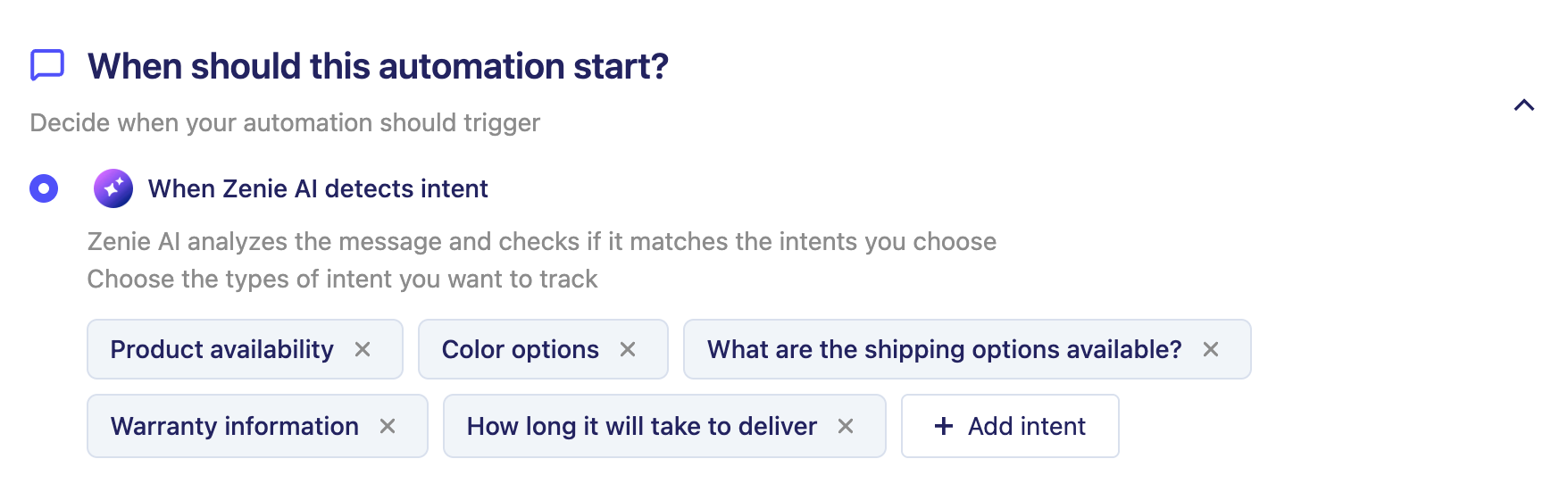
Intent detection aka AI Smart Replies: The better way to automate
Here's the difference:
Let's revisit those same examples:
🛠️ "Love this, but it arrived damaged" → Intent detected: Support issue Zenie understands this isn't purchase interest—it's a customer who needs help. The interaction can be flagged for your support team or routed into a resolution flow.
📦 "Wanttt! When's the restock?" → Intent detected: Product inquiry This person is asking a question, not expressing doubt. They don't need a discount, they need information. Zenie can trigger a restock notification signup or send product availability details.
🛒 "This is perfect for summer!" → Intent detected: Purchase interest ✅ Now we're talking. This comment signals buying intent. This is when an automated DM with a product link, exclusive offer, or personalized recommendation makes sense.
Why this matters
Intent-based automation prevents embarrassing mistakes and helps you transform Instagram into a revenue channel.
Better customer experiences mean stronger relationships and higher lifetime value. When your responses actually match what people need, they feel heard. That builds loyalty.
Smarter spending means your discounts go to fence-sitters, not people already convinced. You're using promotions strategically, not scattering them across every interaction.
Higher conversions happen when you reach the right people at the right moment with the right message. Intent detection ensures your automation is working with the customer journey, not against it.
And here's the bonus: because ZEPIC's Instagram automation is part of a unified Marketing OS, these intent signals don't just trigger AutoDMs—they feed into your broader customer data. That means better segmentation, smarter campaigns, and personalized experiences across email, WhatsApp, and beyond.
In conclusion
Instagram engagement is valuable. Your followers are commenting, DMing, reacting to stories—they're giving you real-time signals about what they want, what they need, and when they're ready to buy.
Keyword automation treats all of that signal like noise, matching words without understanding meaning. Intent detection flips that. It turns every interaction into actionable insight.
So here's the question: Is your Instagram automation actually smart enough to read the room?
Or is it just playing keyword bingo and hoping for the best?
Ready to see what intent-based automation can do? Try Instagram Automation with Zenie AI in ZEPIC and stop leaving conversions (and customer relationships) on the table.
Desperate times call for desperate Google/Chat GPT searches, right? "Best Shopify apps for sales." "How to increase online sales fast." "AI tools for ecommerce growth."
Been there. Done that. Installed way too many apps. But here's what nobody tells you while you're doom-scrolling through Shopify app reviews at 2 AM—that magical online sales-boosting app you're searching for? It doesn't exist. Because if it did, Jeff Bezos would've bought (or built!) it yesterday, and we (fellow eCommerce store owners) would all be retired in Bali by now. Growing a Shopify store and increasing online sales isn’t easy—we get it. While everyone’s out chasing the next “revolutionary” tool/trend (looking at you, DeepSeek), the real revenue drivers are probably hiding in plain sight—right there inside your customer data. After working with Shopify stores like yours (shoutout to Cybele, who recovered almost 25% of their abandoned carts with WhatsApp automation), we’ve cracked the code on what actually moves the needle. Ready to stop app-hopping and start actually growing your sales by using what you already have? Here are four fixes that will get you there!
The Painful Truth: You're probably losing about 70% of your potential sales to cart abandonment. That's not just a statistic—it's real money walking out of your digital door. And looking for yet another Shopify app for abandoned cart recovery isn't going to fix it if you're not getting the fundamentals right.
The Quick Fix: Everyone knows you need multi-channel recovery that hits the sweet spot between "Hey, did you forget something?" and "PLEASE COME BACK!" But here's the reality—most recovery apps are a one-trick pony. They either do email OR WhatsApp, not both. And don't even get us started on personalizing offers based on cart value—that usually means toggling between three different dashboards while praying your apps talk to each other.
Enter ZEPIC: This is where we come in. With ZEPIC's automated Flows, you can: Launch WhatsApp recovery messages (with 95% open rates!) Set up perfectly timed email sequences (or vice versa) Create personalized recovery offers not just on cart value but based on your customer’s behavior/preferences Track and optimize everything from one dashboard
Fix #2: Reactivate past customers today
The Painful Truth: You're probably losing about 70% of your potential sales to cart abandonment. That's not just a statistic—it's real money walking out of your digital door. And looking for yet another Shopify app for abandoned cart recovery isn't going to fix it if you're not getting the fundamentals right.
The Quick Fix: Everyone knows you need multi-channel recovery that hits the sweet spot between "Hey, did you forget something?" and "PLEASE COME BACK!" But here's the reality—most recovery apps are a one-trick pony. They either do email OR WhatsApp, not both. And don't even get us started on personalizing offers based on cart value—that usually means toggling between three different dashboards while praying your apps talk to each other.
Enter ZEPIC: This is where we come in. With ZEPIC's automated Flows, you can: Launch WhatsApp recovery messages (with 95% open rates!) Set up perfectly timed email sequences (or vice versa) Create personalized recovery offers not just on cart value but based on your customer’s behavior/preferences Track and optimize everything from one dashboard
Offering light at the end of the tunnel is Google’s Privacy Sandbox which seeks to ‘create a thriving web ecosystem that is respectful of users and private by default’. Like the name suggests, your Chrome browser will take the role of a ‘privacy sandbox’ that holds all your data (visits, interests, actions etc) disclosing these to other websites and platforms only with your explicit permission. If not yet, we recommend testing your websites, audience relevance and advertising attribution with Chrome’s trial of the Privacy Sandbox.
Top 3 impacts of the third-party cookie phase-out
Who’s impacted
How
What next
Digital advertising and acquisition teams
Lack of cookie data results in drastic fall in website traffic and conversion rate
Review all cookie-based audience acquisition. Sign up for Chrome’s trial of the Privacy Sandbox
Digital Customer Experience
Customers are not served relevant, personalised experiences: on the web, over social channels and communication media
Multiply efforts to collect first-party customer data. Implement a Customer Data Platform
Security, Privacy and Compliance teams
Increased scrutiny from regulators and questions from customers about data storage and usage
Review current cookie and communication consent management, ensure to align with latest privacy regulations


%201.png)