Stop the Guesswork. Compare Performance Instantly with Reports Benchmarking
Divya Murugesan
Head of Product Marketing
January 29, 2026
Marketing performance is rarely static.
Creative fatigue, seasonal behavior, audience shifts, and channel dynamics constantly influence results. What worked last month may not work this month.
The teams that win are the ones that can detect movement early, not weeks later.
Reporting has never been the problem.
Most marketing teams today already have access to metrics like opens, clicks, deliveries, conversions, revenue. The real challenge is interpretation.
A report can tell you what happened during a given time period, but it often doesn’t answer the question marketers care about most: Are we improving, or are we standing still?
To get that answer, teams usually end up doing extra work. Switching between date ranges, pulling exports, comparing last week to this week, or doing quick mental math just to understand whether performance is moving in the right direction.
That friction adds up quickly, especially when you’re tracking multiple channels and journeys.
Introducing Performance Benchmarking Across ZEPIC Reports
We’ve introduced performance benchmarking across all reporting modules in ZEPIC.
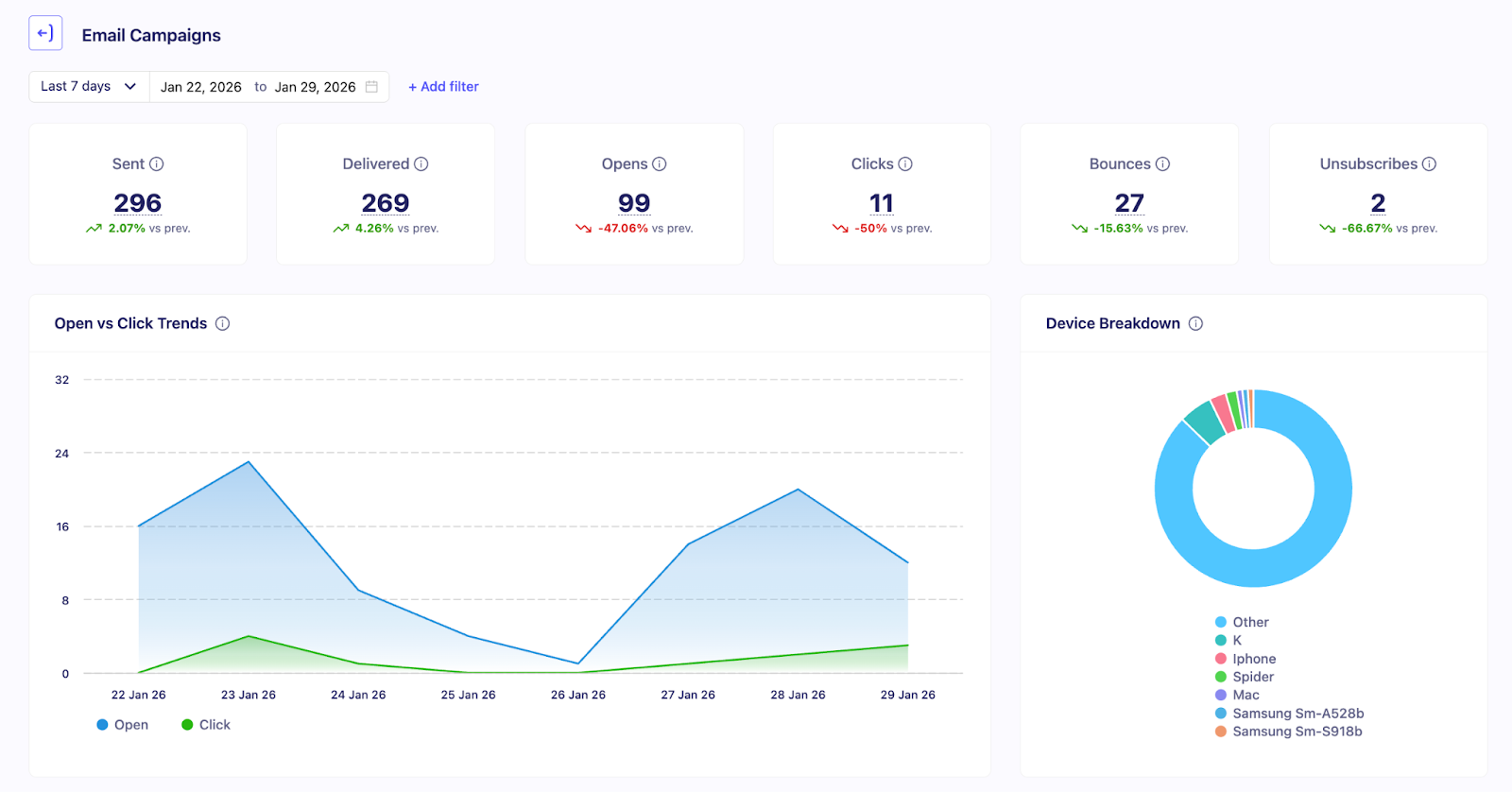
Now, when you select any time period inside Reports, ZEPIC automatically compares it against the previous period and shows percentage change across all key metrics. Instead of viewing metrics in isolation, you immediately get context on direction:
Is performance trending upward?
Are engagement metrics dropping?
Has revenue improved compared to the last timeframe?
This happens automatically, without requiring additional filters, exports, or manual calculations.
Benchmarking helps you answer questions faster, such as:
Are campaigns improving week over week?
Which journeys are performing better than before?
Where are engagement metrics slipping?
What should we prioritize optimizing next?
Instead of treating reporting as a retrospective task, benchmarking makes reporting more actionable.
Benchmarking Built Into Every Key Metric
With Reports Benchmarking, each KPI now includes a clear trend indicator showing whether performance is up, down, or unchanged compared to the previous period.
This makes it easier to spot movement early and understand performance shifts without digging through multiple historical views.
Whether you're reviewing a weekly campaign or tracking ongoing flows, trends are now visible immediately.
One Consistent View Across Channels and Journeys
Reports Benchmarking works across the full ZEPIC Marketing OS, giving teams a consistent way to track performance over time — across channels, workflows, and business outcomes.
You’ll see benchmarking trends across:
Email campaign reporting, including delivery, engagement, and revenue contribution.
WhatsApp campaign performance, where conversations and responses often matter as much as clicks.
Flows and journey analytics, helping you measure whether automations are improving downstream outcomes.
Conversation insights, so you can understand whether dialogue-led engagement is translating into meaningful action.
Revenue and outcome metrics, bringing performance closer to what ultimately matters for the business.
By embedding benchmarking directly into reports, ZEPIC helps teams spend less time analyzing and more time optimizing.
How to Use Reports Benchmarking Effectively
Benchmarking is most useful when it becomes part of your operating rhythm, not something you check once in a while. Here are a few practical ways teams can use it inside ZEPIC.
Use it for weekly performance check-ins
Instead of reviewing metrics in isolation, benchmarking helps you quickly understand what changed compared to last week.
A weekly report becomes much clearer when you can immediately see:
Which campaigns improved
Which flows declined
Whether engagement is trending consistently up or down
It’s a faster way to spot momentum early.
Identify what needs attention without digging
Not every KPI needs deep analysis every time. Benchmark indicators help you triage quickly:
If Opens are down sharply, subject lines or targeting may need work
If Clicks are improving, creative and CTAs may be getting stronger
If Unsubscribes spike, frequency or relevance may need adjustment
You can focus effort where movement is actually happening.
Compare channel performance over time
Teams running both Email and WhatsApp campaigns often struggle to understand where engagement is shifting.
With benchmarking across reporting modules, you can track whether performance improvements are coming from:
Better campaigns
Better segmentation
Better conversational workflows
Over time, this builds a clearer view of what’s driving outcomes.
Track whether optimizations are working
The most common marketing question after making a change is: Did it help?
Benchmarking makes it easy to validate improvements, whether you’ve:
Updated messaging
Adjusted targeting
Changed flow timing
Launched a new offer
Instead of guessing, you can see trend movement immediately in the next period.
Build a habit of continuous improvement
The goal isn’t perfect reporting, it’s consistent progress. Benchmarking turns reports into something more actionable: a simple feedback loop. Small changes, measured clearly, compounded over time.
Get Started
Reports Benchmarking is now available across all reporting modules.
To explore it, head to Reports inside your ZEPIC dashboard, select any timeframe, and you’ll instantly see how performance compares to the previous period.
Desperate times call for desperate Google/Chat GPT searches, right? "Best Shopify apps for sales." "How to increase online sales fast." "AI tools for ecommerce growth."
Been there. Done that. Installed way too many apps. But here's what nobody tells you while you're doom-scrolling through Shopify app reviews at 2 AM—that magical online sales-boosting app you're searching for? It doesn't exist. Because if it did, Jeff Bezos would've bought (or built!) it yesterday, and we (fellow eCommerce store owners) would all be retired in Bali by now. Growing a Shopify store and increasing online sales isn’t easy—we get it. While everyone’s out chasing the next “revolutionary” tool/trend (looking at you, DeepSeek), the real revenue drivers are probably hiding in plain sight—right there inside your customer data. After working with Shopify stores like yours (shoutout to Cybele, who recovered almost 25% of their abandoned carts with WhatsApp automation), we’ve cracked the code on what actually moves the needle. Ready to stop app-hopping and start actually growing your sales by using what you already have? Here are four fixes that will get you there!
The Painful Truth: You're probably losing about 70% of your potential sales to cart abandonment. That's not just a statistic—it's real money walking out of your digital door. And looking for yet another Shopify app for abandoned cart recovery isn't going to fix it if you're not getting the fundamentals right.
The Quick Fix: Everyone knows you need multi-channel recovery that hits the sweet spot between "Hey, did you forget something?" and "PLEASE COME BACK!" But here's the reality—most recovery apps are a one-trick pony. They either do email OR WhatsApp, not both. And don't even get us started on personalizing offers based on cart value—that usually means toggling between three different dashboards while praying your apps talk to each other.
Enter ZEPIC: This is where we come in. With ZEPIC's automated Flows, you can: Launch WhatsApp recovery messages (with 95% open rates!) Set up perfectly timed email sequences (or vice versa) Create personalized recovery offers not just on cart value but based on your customer’s behavior/preferences Track and optimize everything from one dashboard
Fix #2: Reactivate past customers today
The Painful Truth: You're probably losing about 70% of your potential sales to cart abandonment. That's not just a statistic—it's real money walking out of your digital door. And looking for yet another Shopify app for abandoned cart recovery isn't going to fix it if you're not getting the fundamentals right.
The Quick Fix: Everyone knows you need multi-channel recovery that hits the sweet spot between "Hey, did you forget something?" and "PLEASE COME BACK!" But here's the reality—most recovery apps are a one-trick pony. They either do email OR WhatsApp, not both. And don't even get us started on personalizing offers based on cart value—that usually means toggling between three different dashboards while praying your apps talk to each other.
Enter ZEPIC: This is where we come in. With ZEPIC's automated Flows, you can: Launch WhatsApp recovery messages (with 95% open rates!) Set up perfectly timed email sequences (or vice versa) Create personalized recovery offers not just on cart value but based on your customer’s behavior/preferences Track and optimize everything from one dashboard
Offering light at the end of the tunnel is Google’s Privacy Sandbox which seeks to ‘create a thriving web ecosystem that is respectful of users and private by default’. Like the name suggests, your Chrome browser will take the role of a ‘privacy sandbox’ that holds all your data (visits, interests, actions etc) disclosing these to other websites and platforms only with your explicit permission. If not yet, we recommend testing your websites, audience relevance and advertising attribution with Chrome’s trial of the Privacy Sandbox.
Top 3 impacts of the third-party cookie phase-out
Who’s impacted
How
What next
Digital advertising and acquisition teams
Lack of cookie data results in drastic fall in website traffic and conversion rate
Review all cookie-based audience acquisition. Sign up for Chrome’s trial of the Privacy Sandbox
Digital Customer Experience
Customers are not served relevant, personalised experiences: on the web, over social channels and communication media
Multiply efforts to collect first-party customer data. Implement a Customer Data Platform
Security, Privacy and Compliance teams
Increased scrutiny from regulators and questions from customers about data storage and usage
Review current cookie and communication consent management, ensure to align with latest privacy regulations


%201.png)