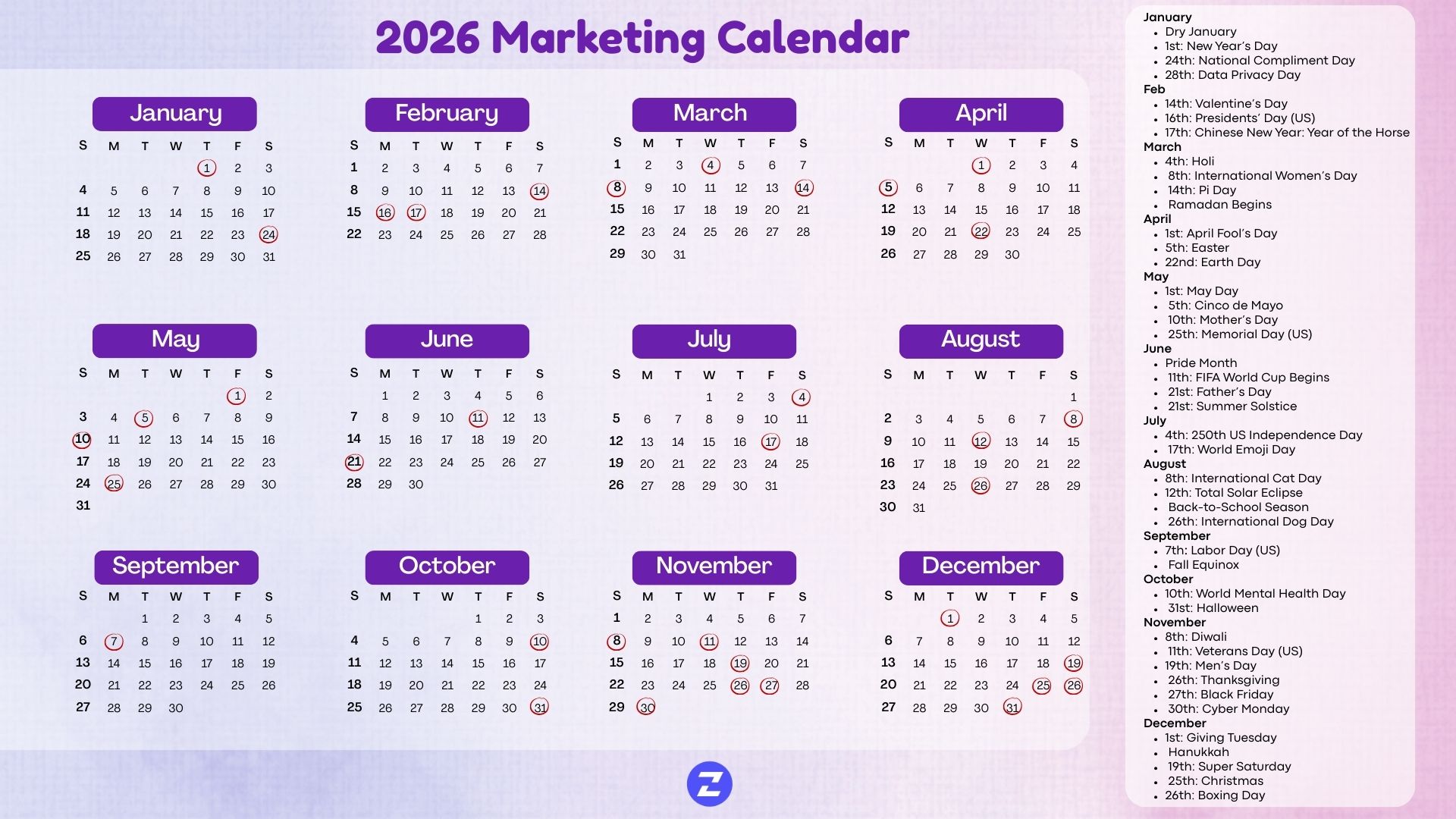
But 2026 will also usher in a shift in how content planning works because AI-assisted workflows, short-form video dominance, and multi-platform integration will become non-negotiable. To win, you need a content calendar that is mapped to funnel goals, market trends, and your broader brand narrative.
|
Month
|
Key Dates
|
Campaign Ideas
|
|
January
|
|
• New Year Resolution series (TOFU)
• Productivity hacks using your product
• Data privacy awareness (great for SaaS/Cybersecurity)
• “Compliment Drop” reels & email campaigns
|
|
February
|
• 14th: Valentine’s Day
• 16th: Presidents’ Day (US)
• 17th: Chinese New Year — Year of the Horse
|
• Valentine’s bundles/gift guides
• “Year of the Horse” ambition/energy-themed promotions
• UGC love stories or customer spotlights
|
| March |
• 4th: Holi
• 8th: International Women’s Day
• 14th: Pi Day
• Ramadan Begins
|
• IWD employee features & donation-linked campaigns
• Holi color-themed creative posts
• Pi Day discounts (“3.14% off”)
• Thoughtful Ramadan prep content
|
| April |
• 1st: April Fool’s Day
• 5th: Easter
• 15th: US Tax Day
• 22nd: Earth Day
|
• Light, harmless April Fool’s prank
• Easter pastel campaigns
• Earth Day sustainability storytelling
• Tax-prep countdown (Finance/Legal brands)
|
| May |
• 1st: May Day
• 5th: Cinco de Mayo
• 10th: Mother’s Day
• Memorial Day (US)
|
• Mother’s Day multi-market gift guide
• Emotional storytelling ads
• Summer-prep checklists
• Memorial Day long-weekend sales
|
| June |
• Pride Month
• 11th: FIFA World Cup Begins
• 21st: Father’s Day
• 21st: Summer Solstice
|
• Pride Month awareness or charity tie-ins
• FIFA-themed content (“Best in the World” lists, predictions)
• Summer launches (travel/fitness/beauty)
• Father’s Day gift toolkits
|
| July |
• 4th: 250th US Independence Day
• 17th: World Emoji Day
|
• Legacy/history storytelling campaigns
• Emoji-themed Reels and engagement posts
|
| August |
• 8th: International Cat Day
• 12th: Total Solar Eclipse
• Back-to-School Season
• 26th: International Dog Day
|
• Solar Eclipse “moment marketing”
• Back-to-school checklists & offers
• Pet UGC drives (super high engagement!)
|
| September |
• Labor Day (US)
• Rosh Hashanah / Yom Kippur
• Fall Equinox
|
• End-of-summer clearance
• Fall reset content (work-life, productivity)
• Goal-setting challenges
|
| October |
• 10th: World Mental Health Day
• 31st: Halloween
|
• Mental health awareness or expert-led content
• Spooky Savings campaign
• Creator-driven costume or DIY content
|
| November |
• 8th: Diwali
• 11th: Veterans Day (US)
• 19th: International Men’s Day
• 26th: Thanksgiving
• 27th: Black Friday
• 30th: Cyber Monday
|
•Diwali gifting series
•Men’s Day Discounts
•Early BFCM teasers (start early Nov)
•Cart-recovery automation via Email & WhatsApp before BFCM weekend
•VIP early-access BFCM deals
|
| December |
• 1st: Giving Tuesday
• Hanukkah
• 19th: Super Saturday
• 25th: Christmas
• 26th: Boxing Day
• 31st: New Year’s Eve
|
• “12 Days of Deals” campaign
• Holiday gift guides
• Year-end wrap-ups & gratitude notes
• Last-minute shopping reminders
|
Focus on High-Impact Global Moments (Deeper Dive)
Certain events in 2026 will command global attention. Use them strategically for maximum organic and paid traction.
1. FIFA World Cup 2026 (June 11–July 19)
This is a period with massive search volume, global engagement, 24/7 attention. You can use:
- Prediction series
- Country-themed content
- “Match Day Deals”
- Reels highlighting “Best in the World” lists
Perfect for brands in food delivery, travel, sports, gaming, and e-commerce.
2. The BFCM Season (Nov 27–30)
Marketers must prepare 60–90 days in advance. Key strategies:
- Early-bird VIP lists
- Flash deals
- Cart abandonment recovery
- WhatsApp-triggered offers
Limited-edition bundles
3. The 250th US Independence Day (July 4, 2026)
This is a once-in-a-generation storytelling moment. Use it to highlight:
- Legacy
- Heritage
- Brand evolution
- Major product launches
Why Planning Your 2026 Marketing Calendar Now Is Critical
The Competitive Edge of Early Planning
Brands are planning earlier than ever. This is especially true for:
- BFCM campaigns, which now need 90–120 days of warm-up.
- Global sporting events, where ad inventory sells out quickly.
- Seasonal e-commerce peaks, when attention spans are shorter.
When you prepare your 2026 content calendar in Q4 2025 (or earlier), you ensure:
- Clear creative direction
- Budget alignment
- Better localization
- Smart trend integration
- First-mover advantage
What’s Changing in 2026? Key Trends
Several shifts are redefining content strategies:
- AI-Integrated Workflows: Content ideation, personalization, and distribution now rely heavily on AI tools.
- Short-Form Video Dominance: TikTok, Reels, and Shorts will remain the backbone of discovery.
- Hyper-Personalization: User intent, browsing behavior, and micro-moments drive messaging.
- Community-Led Content: UGC, testimonials, and creator partnerships are trusted more than brand-led narratives.
The Strategic Foundation: Building Your 2026 Calendar
Start by defining the strategy that will govern your content decisions throughout the year.
A. Define Your Funnel Goals (TOFU, MOFU, BOFU)
Your content calendar should guide users through the funnel:
1. TOFU (Awareness)
Use fun, high-volume dates like New Year, Holi, International Cat Day, and Women’s Day.
Examples: Trendjacking posts, memes, challenges, and educational content.
2. MOFU (Consideration)
Map content to months with moderate purchase intent (e.g., back-to-school season, pre-Diwali, pre-summer).
Examples: Deep-dive guides, comparison posts, case studies, and email sequences.
3. BOFU (Conversion)
Focus heavily on purchase-driven moments like BFCM, Christmas, Independence Day, Ramadan/Eid, etc.
Examples: Discounts, flash sales, retargeting ads, bundles, and WhatsApp broadcasts.
Pro Tip:
Create a three-layered content calendar:
- Yearly Tentpoles
- Monthly Themes
- Weekly Funnel Progressions
B. Apply the 60/40 Rule
A high-performing 2026 content strategy must balance:
60% Evergreen / Brand Building
- Blog posts
- Thought leadership
- Community content
- Educational videos
- Brand stories
40% Conversion-Driven / Date-Based Content
- Holiday campaigns
- Limited-edition drops
- Seasonal sales
- Event-driven content
This helps increase sustainable traffic (evergreen) and episodic spikes in revenue (seasonal)
Integrate 2026-Ready Trends
|
Trend
|
How to integrate it in your calendar
|
|
Short-form video
|
Plan 3–5 reels per major date; create sequenced storytelling videos.
|
|
UGC
|
Allocate monthly creator partnerships; encourage audience submissions.
|
|
AI-assisted content
|
Automate repurposing: long-form → reel → email → carousel.
|
|
Community engagement
|
Monthly AMAs, polls, behind-the-scenes, and WhatsApp groups.
|
Wrapping Up
You’ve got the dates, the campaign ideas, and the strategic foundation to tackle 2026. The shift to AI, short video, and personalization is an opportunity to be more creative and more connected with your audience than ever before.
Remember, the best content calendar is the one that allows your team to collaborate smoothly and adapt quickly. Start with the big moments (like the World Cup!) and build your weekly rhythm around clear funnel goals.
Use ZEPIC to automate your campaigns, personalize your customer journeys, and scale your e-commerce growth with confidence. Check out our detailed 2026 marketing calendar.
Start with ZEPIC today and make 2026 your most profitable year.
Frequently Asked Questions
How far in advance should I plan my 2026 content calendar?
Start planning in Q4 2025 for Q1 2026. For major events like the FIFA World Cup and BFCM, begin 12 months ahead.
What are the biggest marketing trends to watch for in 2026?
The major trends include:
• AI-driven personalization
• Short-form vertical video
• Community-led content and UGC
• Commerce-integrated platforms (Instagram Shop, TikTok Shop)
How can I find dates relevant to my niche?
Check the following sources:
• Industry conferences
• Trade shows
• Historical launch anniversaries
• Competitor calendars
• Manufacturer or brand announcements
What’s the difference between a content calendar and a campaign calendar?
Content Calendar: Day-to-day posts, themes, and formats.
Campaign Calendar: Large, goal-driven marketing events with multi-channel planning.
How can small businesses leverage big holidays like FIFA or BFCM?
Small businesses can leverage big events through:
• Hyper-local content
• Narrow product focus
• Viewing parties or community events
• Creator partnerships
• Affordable micro-campaigns on Instagram or WhatsApp
Desperate times call for desperate Google/Chat GPT searches, right? "Best Shopify apps for sales." "How to increase online sales fast." "AI tools for ecommerce growth."

Been there. Done that. Installed way too many apps.
But here's what nobody tells you while you're doom-scrolling through Shopify app reviews at 2 AM—that magical online sales-boosting app you're searching for? It doesn't exist. Because if it did, Jeff Bezos would've bought (or built!) it yesterday, and we (fellow eCommerce store owners) would all be retired in Bali by now.
Growing a Shopify store and increasing online sales isn’t easy—we get it. While everyone’s out chasing the next “revolutionary” tool/trend (looking at you, DeepSeek), the real revenue drivers are probably hiding in plain sight—right there inside your customer data.
After working with Shopify stores like yours (shoutout to Cybele, who recovered almost 25% of their abandoned carts with WhatsApp automation), we’ve cracked the code on what actually moves the needle.
Ready to stop app-hopping and start actually growing your sales by using what you already have? Here are four fixes that will get you there!
Fix #1: Convert abandoned carts instantly (Like, actually instantly)
The Painful Truth: You're probably losing about 70% of your potential sales to cart abandonment. That's not just a statistic—it's real money walking out of your digital door. And looking for yet another Shopify app for abandoned cart recovery isn't going to fix it if you're not getting the fundamentals right.
The Quick Fix: Everyone knows you need multi-channel recovery that hits the sweet spot between "Hey, did you forget something?" and "PLEASE COME BACK!" But here's the reality—most recovery apps are a one-trick pony. They either do email OR WhatsApp, not both. And don't even get us started on personalizing offers based on cart value—that usually means toggling between three different dashboards while praying your apps talk to each other.
Enter ZEPIC: This is where we come in. With ZEPIC's automated Flows, you can:
Launch WhatsApp recovery messages (with 95% open rates!)
Set up perfectly timed email sequences (or vice versa)
Create personalized recovery offers not just on cart value but based on your customer’s behavior/preferences
Track and optimize everything from one dashboard

Fix #2: Reactivate past customers today
The Painful Truth: You're probably losing about 70% of your potential sales to cart abandonment. That's not just a statistic—it's real money walking out of your digital door. And looking for yet another Shopify app for abandoned cart recovery isn't going to fix it if you're not getting the fundamentals right.
The Quick Fix: Everyone knows you need multi-channel recovery that hits the sweet spot between "Hey, did you forget something?" and "PLEASE COME BACK!" But here's the reality—most recovery apps are a one-trick pony. They either do email OR WhatsApp, not both. And don't even get us started on personalizing offers based on cart value—that usually means toggling between three different dashboards while praying your apps talk to each other.
Enter ZEPIC: This is where we come in. With ZEPIC's automated Flows, you can:
Launch WhatsApp recovery messages (with 95% open rates!)
Set up perfectly timed email sequences (or vice versa)
Create personalized recovery offers not just on cart value but based on your customer’s behavior/preferences
Track and optimize everything from one dashboard
Offering light at the end of the tunnel is Google’s Privacy Sandbox which seeks to ‘create a thriving web ecosystem that is respectful of users and private by default’. Like the name suggests, your Chrome browser will take the role of a ‘privacy sandbox’ that holds all your data (visits, interests, actions etc) disclosing these to other websites and platforms only with your explicit permission. If not yet, we recommend testing your websites, audience relevance and advertising attribution with Chrome’s trial of the Privacy Sandbox.
Top 3 impacts of the third-party cookie phase-out
Who’s impacted
How
What next
Digital advertising and
acquisition teams
Lack of cookie data results in drastic fall in website traffic and conversion rate
Review all cookie-based audience acquisition. Sign up for Chrome’s trial of the Privacy Sandbox
Digital Customer Experience
Customers are not served relevant, personalised experiences: on the web, over social channels and communication media
Multiply efforts to collect first-party customer data. Implement a Customer Data Platform
Security, Privacy and Compliance teams
Increased scrutiny from regulators and questions from customers about data storage and usage
Review current cookie and communication consent management, ensure to align with latest privacy regulations


%201.png)